
De-risking the Product Lifecycle: The Engineering Mandate for Circular Architecture
Supply chain architecture is facing an unprecedented convergence of macroeconomic risks. Regulatory tightening, geopolitical friction, and resource scarcity are rendering traditional linear manufacturing models obsolete. Yet, many corporate boards continue to relegate circular economy initiatives to corporate social responsibility departments.
This perspective represents a significant operational error. According to research with our High Value Manufacturing Catapult (HVMC) partnership sustainability has ceased to be a matter of abstract corporate ethics. It has transitioned into a necessary structural de-risking strategy for high-value manufacturing.
The Vulnerability of Linear Habits
Businesses operating on short-term linear habits are highly exposed to market forces. When an organization relies entirely on virgin raw material extraction, it accepts absolute exposure to resource volatility and geopolitical choke points. The consequences of this structural dependency are clear across the current industrial landscape:
-
Market Risk: Luxury car manufacturers, including Porsche AG, have been forced to cut annual profit forecasts following sudden shortages of critical aluminium components, highlighting the fragility of primary input dependencies.
-
Regulatory Risk: The implementation of the EU carbon border tax introduces severe compliance penalties for unhedged importers utilizing carbon-heavy supply chains.
-
Reputational Risk: Major retailers face landmark lawsuits regarding forced labour within overseas supplier factories, showing that unmonitored tiers of procurement carry existential corporate risk.
These events are not isolated operational anomalies; they are the logical consequence of product design that ignores planetary boundaries and social foundations.
Challenging the Flawed Premise of Standalone Circularity
A common management blind spot is the assumption that adopting any circular model will inherently yield operational stability. This hypothesis is flawed. Naive circularity, implemented without rigorous engineering parameters, frequently swaps global supply constraints for complex localized operational bottlenecks.
If secondary material recovery loops are erratic, impure, or poorly integrated into the initial product design, the system fails. Circularity only serves as a genuine resilience asset when it is treated as a core product architecture discipline, governed by quantifiable data and standardized compliance metrics.
The Solution: The HVMC Design for Sustainable Circularity (DfSC) Framework
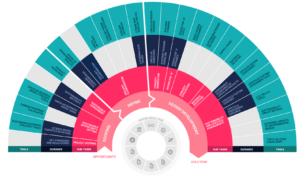
To bridge the gap between high-level sustainability goals and practical shop-floor execution, HVMC developed the Design for Sustainable Circularity (DfSC) framework. Rather than acting as a static conceptual model, the DfSC framework operates as a functional guide that connects previously disassociated engineering tools directly to the product lifecycle. The framework structures design requirements across four distinct pillars:
-
Environmental Design: Focuses on creating restorative, regenerative, and waste-free systems that minimize finite material extraction, eliminate greenhouse gas emissions, and prevent regional pollution.
-
Social Design: Integrates ethical sourcing, community engagement, and protective labor practices directly into supply chain selection to eliminate human rights hazards.
-
Economic Design: Optimizes the total cost of ownership, drives manufacturing efficiency, and creates residual asset value to ensure long-term profitability.
-
Foundational Resilience: Employs comprehensive systems thinking and decision traceability to future-proof product design against shifting regulations and unknowable market threats.
Mapping the Process: Scope, Define, Develop
The framework materializes by mapping these four pillars directly onto standard industrial product design phases:
-
Scope (Define the Opportunity): Setting non-negotiable ambitions and hard boundaries for environmental, social, and economic targets from day one.
-
Define (Discover Risk): Conducting gap analyses, discovering lifecycle hotspots, and translating identified vulnerabilities into hard engineering specifications.
-
Design Development (Inclusion, Restoration, Adaptation): Generating and evaluating concepts using rigorous engineering tools to ensure the final product architecture matches corporate resilience goals.
Empirical Validation: Case Studies in Resilient Engineering
The commercial utility of this framework is proven by pilot applications across distinct sectors. The DfSC methodology was used to refine the development of Lignoo’s sustainable children’s water bottle, helping the venture translate ethical commitments into standardized, scalable circular material choices. This design iteration secured critical validation, culminating in the founder receiving the prestigious UK Women in Innovation Award.
Similarly, the framework was applied to another organisations proprietary “RiPR” technology, which utilizes supercritical water gasification to convert wet organic waste into green biomethane. By executing precise Techno-Economic Assessments (TEA) and Life Cycle Assessments (LCA) within the DfSC matrix, engineers mapped the technology’s performance directly against established planetary boundaries. These examples demonstrate that circular design is highly technical and commercially viable when governed by a structured framework.
The “So What?”: Executive Enablement
What is the ultimate business takeaway? The DfSC framework alters executive capability. It provides chief risk officers, procurement directors, and lead engineers with a standardized playbook to map, quantify, and design out operational liabilities. It enables organisations to shift from reactive crisis mitigation to proactive material autonomy.
By re-engineering products to be circular by default, companies protect their long-term margins, insulate operations from commodity shocks, and convert regulatory compliance from a cost center into a clear competitive advantage.
Please reach out if you are curious about this framework and want further information to support your industry through resilience and sustainable product design for circularity.