
Form Follows Availability: The Financial Case for Resilient Product Design
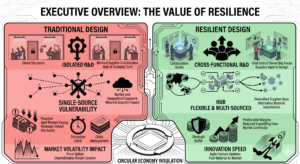
The cost of supply chain disruptions is no longer an occasional line item on a profit and loss statement; it is a structural tax on inefficient design. Research by the McKinsey Global Institute indicates that supply chain disruptions cost companies, on average, 45% of one year’s profits over the course of a decade. While many executives focus on building inventory buffers or nearshoring suppliers to mitigate this risk, the most effective financial lever sits much earlier in the product lifecycle: the design phase. Up to 80% of a product’s environmental and supply chain footprint is determined during its initial design (European Commission, 2022). Manufacturers that decouple design from procurement strategy invite systemic financial vulnerability.
Traditional product development prioritises performance metrics and direct material costs. Engineers select components that optimise functionality, often resulting in highly customised, single-sourced parts. This approach creates a rigid supply chain. If a single tier-one supplier faces a factory shutdown, a regulatory hurdle, or a logistical bottleneck, the entire manufacturing line halts. The financial consequences are severe, involving expedited freight fees, emergency component redesigns, and lost market share.
Resilient product design addresses these vulnerabilities by treating supply chain viability as a core design constraint. This methodology relies on three structural principles: standardisation, modularity, and circularity.
Component Standardisation and Platforming
Designing for resilience requires minimising unique part numbers across a product portfolio. Platforming involves developing a shared architecture across multiple product lines. When different products utilise the same microprocessors, fasteners, or structural brackets, procurement teams can aggregate demand.
This approach yields two distinct financial advantages:
-
Purchasing Leverage: Bulk purchasing lowers the unit cost and elevates the manufacturer’s status with suppliers, ensuring preferential allocation during shortages.
-
Inventory Flexibility: Excess inventory for one product line can seamlessly buffer shortages in another, reducing total carrying costs and obsolescence risks.
Modular Architecture
A modular design isolates specific functional components into independent sub-assemblies. If a component becomes unavailable due to geopolitical tension or material scarcity, engineers can modify that specific module without altering the entire product framework. This prevents the need for wholesale product recertification, a process that can take months in regulated sectors like automotive or medical device manufacturing. Modularity allows for plug-and-play substitution, enabling production lines to remain operational during volatile market shifts.
Designing for Circularity and Remanufacturing
Resilient design extends beyond the initial point of sale. By engineering products for easy disassembly, manufacturers can establish closed-loop systems. When a product reaches the end of its life, it can be returned, dismantled, and refurbished. This strategy provides a stable, predictable stream of secondary raw materials that are completely insulated from global commodity market shocks.
Comparative Data: Strategic Paradigms
The following table illustrates the operational and financial divergence between traditional design methodologies and the resilient model.
| Metric / Attribute | Traditional Product Design | Resilient Product Design |
| Component Selection | Customised, single-source specification based on lowest initial unit cost. | Standardised, multi-sourced components chosen for long-term availability. |
| Disruption Response | Reactive engineering changes, spot-market premiums, production downtime. | Seamless component substitution via modular architecture; zero line stoppages. |
| Inventory Profile | High volume of unique, specific safety stocks across multiple part numbers. | Consolidated, interchangeable safety stock across product platforms. |
| End-of-Life Value | Write-offs, landfill costs, complete loss of embodied material value. | Material recovery, asset remanufacturing, reduced raw material dependency. |
The Operational Roadmap for Leadership
Transitioning to a resilient design framework requires structural changes to corporate governance and engineering workflows. Executives must implement three specific operational updates to capture these cost savings.
First, manufacturers must integrate supply chain risk data directly into the Product Lifecycle Management (PLM) software. Engineers should have real-time visibility into supplier geographic concentration, lead times, and financial health scores at the moment they select a component, rather than waiting for a procurement review after design completion.
Second, companies must reform internal incentive structures. Engineering performance metrics are traditionally tied to hitting launch dates and bill-of-materials cost targets. These metrics must expand to include supply chain health indicators, such as the percentage of multi-sourced parts or the degree of component reuse across platforms.
Finally, organizations need to establish formal cross-functional gate reviews. Representatives from procurement, logistics, and sustainability must hold veto power at critical design milestones. If a proposed design introduces an unmitigated supply chain single point of failure, it must be rejected before moving to tooling or production.
Designing for resilience alters the cost structure of manufacturing. It replaces reactive crisis management with proactive risk mitigation, ensuring that the products designed today remain profitable through the supply chain disruptions of tomorrow.