
Supply Chain Resilience Navigator – The Alignment between Industry and WMG
The conversation has shifted sharply.
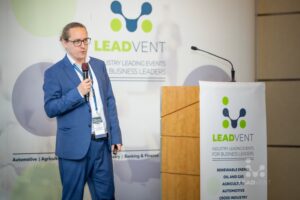
At the Leadvent Group’s 3rd Annual Supply Chain Risk and Resilience Forum in Amsterdam last week, I sat in a room with senior practitioners from Vestas, Maersk, Procter & Gamble, KION Group and FMC Corporation – organisations operating at a genuinely global scale. What struck me wasn’t any single insight, but the degree of alignment on what resilience actually requires right now.
There was clear alignment between how we at WMG, University of Warwick approach supply chain resilience and the approaches adopted by major international organisations. This validation underscores the utility of the upcoming V2 of our Supply Chain Resilience Navigator (see below).
Rather than treating resilience as a static capability, the discussions from the following resilience experts highlighted that modern supply chains require a dynamic, structural overhaul to manage multi-tier risk.
Greg Schlegel CPIM, CSP, Jonah and Jim de Vries at The Supply Chain Risk Management Consortium demonstrated that traditional supply chain maps are obsolete. Resilience requires N-tier transparency frameworks to capture early disruption signals far upstream.
Sidsel Nørregaard (Vestas) outlined the operational levers required to balance resilience strategies across short-, medium-, and long-term horizons.
Presentations led by Mostafa Salem (Procter & Gamble) and Jakub Watemborski (KION Group) highlighted the critical role of execution capability during simultaneous crises and the growing multiplier effect of supplier-first cyber resilience.
Arghajit Adhicary and Zera Zheng (A.P. Moller – Maersk) focused on the macro and technological reality, with Arghajit focused on operationalising resilience amidst geopolitical shifts and regulatory acceleration. Whereas, Zera Zheng tackled the data paradox, addressing how organisations must bridge the gap between automated AI risk signals and actual human judgment.
Caio Gouveia (FMC Corporation) provided a critical reality check on digital tools, arguing that advanced supply chains poorly optimise for reality, requiring that good governance must precede technology and that human judgment becomes more vital as automation scales.
The overarching insight from the forum is that resilience and cost efficiency are not mutually exclusive trade-offs; they are leadership choices.
Buffer stocks alone cannot solve structural fragility. Instead, organisations must calibrate their internal maturity, embrace trusted data-sharing models, and reduce internal complexity to build execution speed.
Resilience Navigator Launch Event
To help UK manufacturers understand their maturity for resilience and take actionable solutions, we are launching V2 of the Supply Chain Resilience Navigator on the Digital Supply Chain Hub on the 24th of June.
Please register via the link below:
About me
Dr Luke Bellamy is the Lead Engineer for Industrial Resilience within the CTO team at WMG, University of Warwick. Operating at the intersection of empirical research and industrial application, he designs frameworks that translate complex supply chain vulnerabilities into actionable business strategies.
Luke is the primary architect of the Supply Chain Resilience Navigator, a standardised digital capability assessment tool used by UK manufacturers to quantify and mitigate operational risk. His expertise spans material sovereignty, design for circularity, and the security of critical mineral supplies. In collaboration with the High Value Manufacturing Catapult, his current work integrates supply chain resilience with total cost of ownership (TCO) models and sustainable finance mechanisms. He holds a PhD in Supply Chain Sustainability Risk from Loughborough Business School and actively welcomes strategic networking with organisations seeking empirical backing for their sustainability and resilience ambitions.