
The Hormuz Stalemate: Why Conflicting Ceasefire Narratives Triggered a New Global Supply Chain Shockwave
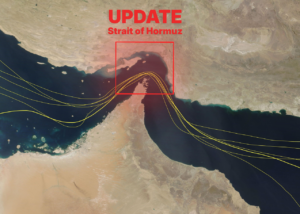
A fundamental miscalculation currently skews corporate risk assessments across international supply chains, that geopolitical “breakthroughs” instantly translate to maritime safety. The rapid unravelling of the mid-June maritime memorandum of understanding (MoU) between the United States and Iran caused headaches for supply chain managers globally.
While diplomatic declarations suggested a stabilization of the corridor, the practical reality for commercial vessels remains highly volatile. For procurement and logistics executives, the immediate consequence is a prolonged state of operational uncertainty that threatens manufacturing continuity.
The Anatomy of a 24-Hour Collapse
According to maritime intelligence assessments compiled by CBC News, conflicting political narratives from Western and Iranian leadership have created profound operational friction. Ian Ralby, a non-resident senior fellow at the Center for Maritime Security, stated that the strait is not open in any meaningful commercial capacity. Before regional hostilities erupted in February 2026, the corridor accommodated between 130 and 160 commercial vessels daily. Following the initial MoU, traffic briefly spiked to 25 transits before plunging back to single digits.
Reports from BBC News indicate that the Islamic Revolutionary Guard Corps (IRGC) justified its quick re-closure by citing continuous military operations in southern Lebanon as a breach of the ceasefire. While high-level negotiations have commenced in Switzerland under Pakistani mediation, with Vice President JD Vance leading the American delegation, the ground reality remains highly precarious. Shippers report warning shots fired across commercial bows alongside marine radio broadcasts stating that no vessel may enter without an explicit passage permit from the Persian Gulf Strait Authority (PGSA).
Intelligence profiles published by Discovery Alert indicate that the temporary traffic recovery stalled within 24 hours of its announcement. The regional traffic profile has reverted entirely to the late-blockade baseline rather than a functioning open waterway.
Physical Hazards and Operational Bottlenecks
The threat to commercial assets is not confined to military interventions; it is driven by severe physical degradation of the waterway itself. Data published by The Guardian reveals that the centre of the Strait of Hormuz is obstructed by approximately 80 sea mines laid within the historic traffic separation scheme.
Chubb Ltd chief executive Evan Greenberg characterised the operating environment as an active war zone, noting that only a single narrow channel remains accessible for commercial navigation. This spatial restriction severely limits daily throughput capacity.
Phil Belcher, marine director at the independent tanker owner trade body Intertanko, compared the current routing to a multi-lane highway where the main road is blocked, forcing commercial traffic onto the hard shoulder. Vessels attempting to navigate the southern corridor through Omani waters face extreme risks of running aground on coastal rocks. This geographical bottleneck is further complicated by widespread Iranian electronic signal jamming, forcing container ships and oil tankers to navigate these narrow passages blind.
The resulting backlog creates structural friction that minor diplomatic adjustments cannot resolve. Although the first commercial ships recently passed through under a specialised United Nations evacuation scheme, this mechanism functions as a crew relocation framework rather than a restorer of commercial freight velocity.
Richard Meade, editor-in-chief of Lloyd’s List, observed that approximately 600 vessels have remained anchored in the Gulf since February 2026, concluding that the accumulated backlog will not clear within this calendar year. Peter Sand, chief analyst at Xeneta, warned that 10 per cent of global container shipping capacity remains directly impacted by the blockade, triggering spiralling freight rates across major international trade lanes.
The operational degradation becomes stark when current metrics are measured against historical baselines. Daily commercial transits through the corridor have declined from a norm of 130 to 160 vessels to single-digit figures, causing a backlog of approximately 600 anchored vessels. This halt to previously free-flowing trade has trapped up to 470,000 twenty-foot equivalent units (TEUs) of container capacity within the Gulf. Consequently, a network that once relied on a fully optimised fleet must now absorb the sudden removal of 10 per cent of global container capacity from active service.
Escalating Financial and Compliance Risks
Beyond physical security risks, commercial operators face an escalating legal and financial dispute that alters the total landed cost of freight. Tehran intends to charge a mandatory maritime passage fee to all vessels crossing the strait following a 60-day window.
A spokesperson for the German container line Hapag-Lloyd characterised the proposed toll as fundamentally wrong, noting that infrastructure fees for the Suez or Panama Canals reflect massive capital investments, whereas the Strait of Hormuz constitutes international waters. The ocean freight industry is concerned that allowing Iran to collect these fees will establish a dangerous precedent for other critical shipping channels, such as the Strait of Malacca.
Furthermore, maritime data indicates that nearly 20 per cent of traffic consists of sanctioned vessels linked to Iran’s shadow fleet. This factor introduces significant compliance and legal risks for Western corporations attempting to audit their shipping networks.
Evaluating the Strategic Alternatives
To safeguard organisational resilience against these compounding chokepoint failures, supply chain leaders must evaluate two competing options for network management.
Option 1: The Reactive Mitigation Model
This option views the crisis as a cyclical geopolitical spike. The corresponding action plan relies on short-term tactical adjustments: absorbing spot-market freight rate spikes, leveraging temporary UN evacuation protocols, and waiting for a conclusive political settlement from the Swiss mediation talks. This strategy minimises immediate capital expenditure but leaves the network highly vulnerable to extended diplomatic deadlocks.
Option 2: The Structural Network Decoupling Model
This approach recognizes that the era of predictable maritime logistics has undergone a permanent shift. The 14-day detour required to route ocean vessels around the Cape of Good Hope compresses global fleet capacity, doubling import dwell times at secondary transshipment hubs like Jawaharlal Nehru Port in India.
The remedy requires a complete structural reconfiguration of the supply chain network to remove single-point failure dependencies:
-
Multi-Tier Supplier Audits: Map all tier-one and tier-two component lines to isolate dependencies on raw materials or sub-assemblies routed through the Persian Gulf.
-
Multimodal Routing Commitments: Establish pre-cleared contract agreements for alternative overland rail or western Saudi Arabian port gateways to bypass the chokepoint entirely.
-
Inventory Capital Recalibration: Shift working capital models from just-in-time efficiency to just-in-case buffers, absorbing higher carrying costs as a mandatory premium for operational continuity.
Relying on external political stability is an operational vulnerability. The events of the past week demonstrate that diplomatic agreements do not guarantee physical passage on the water. Long-term supply chain security belongs exclusively to organizations that design their logistics infrastructure to withstand the permanent reality of disruption.
Sources:
-
Strait of Hormuz: Conflicting Narratives, CBC News, 21 June 2026
-
Normal shipping will not resume in Strait of Hormuz until mines cleared, The Guardian, 19 June 2026
-
Strait of Hormuz Shipping Disruption: What’s at Stake in 2026, Discovery Alert, 23 June 2026
-
Ceasefire breach and Swiss mediation updates, BBC News, June 2026
-
Tracking the Iranian Shadow Fleet and UN Evacuation Schemes, MSN / Maritime Analytics, June 2026