
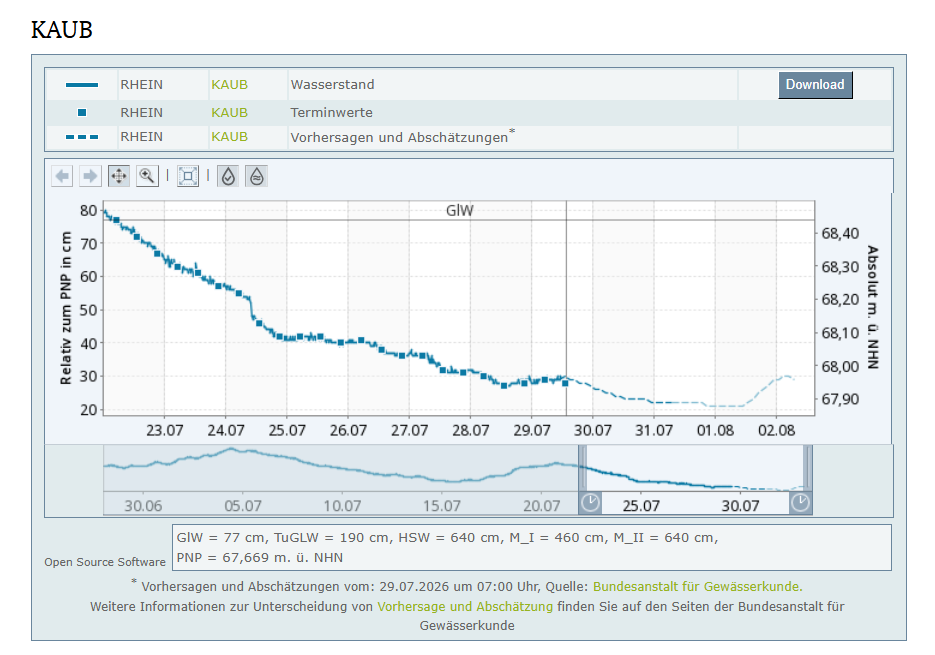
Water levels at the critical Kaub gauge on the Rhine River have dropped below 30 centimetres, crippling barge transport along Europe’s primary industrial artery. This physical bottleneck directly threatens bulk feedstock movements, forcing chemical manufacturers to issue force majeure warnings and reassess European supply chain viability.
Overall Summary
Drought conditions across Central Europe have severely depleted the Rhine River, dropping water levels at the Kaub choke point to under 30 centimetres. Speaking at BASF’s H1 2026 earnings conference, Chief Executive Officer Markus Kamieth confirmed that extreme shallow-draft conditions are severely restricting barge cargo capacity. Consequently, BASF warned that product shortages and force majeure declarations from its flagship Ludwigshafen manufacturing complex may become unavoidable.
Ludwigshafen, the world’s largest integrated chemical complex, relies heavily on river barges to import bulk liquid feedstock and export finished products. Reduced draft capabilities have forced operators to run barges at less than 25 percent capacity, creating immediate inventory deficits and operational bottlenecks across downstream manufacturing sectors.
Analysis: Business Implications for Executive Leadership
The drop in Rhine water levels represents a structural, recurring vulnerability for European industry rather than a temporary weather disturbance. Climate patterns show that low-water events at Kaub occur with regular frequency during summer months. Executive leadership must address four major business implications:
-
Margin Compression: Splitting bulk liquid barge shipments across multiple shallow-draft vessels or switching to rail and road transport increases transport costs by up to 300 percent per tonne. Rail and road network infrastructure across Western Europe lacks the immediate spare tank-car and driver capacity to absorb bulk liquid volumes from river shipping.
-
Force Majeure Exposure: Force majeure declarations disrupt downstream production schedules, triggering contractual penalty claims and stockouts for European manufacturers reliant on precursor chemicals.
-
Misallocation of Capital: Relying on reactive spot-chartering of specialised low-draft vessels diverts capital away from long-term logistics redesign and asset diversification.
-
Systemic Interdependence: Ludwigshafen acts as a foundational supplier for European manufacturing value chains. Reduced chemical output at this single node creates cascading production halts across automobile assembly plants, plastics fabrication, and pharmaceutical processing across the continent.
Strategic Shift: Flawed Mindsets versus Resilient Execution
Logistics Risk Management
The traditional approach treats river transport disruptions as unpredictable, short-term weather anomalies, leading to reactive operational adjustments. Resilient execution mandates integrating seasonal water-level predictive models directly into dynamic multi-modal transport planning.
Buffer Inventory Strategy
Legacy supply chain models maintain minimal lean inventory buffers near inland waterway manufacturing hubs to optimise balance sheets. High-performing organisations establish distributed buffer inventory hubs along resilient rail corridors and coastal deep-sea terminals to absorb inland supply shocks.
Fleet Infrastructure
Standard supply strategies rely on heavy-draft barges, attempting to bridge capacity gaps through spot-market vessel chartering when water levels decline. Operational resilience requires commissioning dedicated shallow-draft fleets and securing long-term multi-modal capacity reservation contracts well before low-water conditions occur.
Sourcing Topology
Conventional sourcing relies on single-sourcing precursor chemicals from river-dependent manufacturing clusters due to historical cost efficiencies. Modern risk mitigation requires mandating dual-sourcing architectures anchored by coastal chemical cluster redundancy.
Source References
-
ICIS News (July 2026), Low-Water Vulnerabilities & Force Majeure Warnings on the Rhine.
-
BASF H1 2026 Earnings Conference Transcript, Statement by CEO Markus Kamieth.